
How to Create a Luxury Bedroom on a Considered Budget

A luxury bedroom is not a function of how much you spend, it is a function of material quality, cohesion, and restraint. The rooms that feel genuinely luxurious share the same properties: a consistent neutral palette, layered natural textures, quality bed linen, considered lighting, and an absence of visual clutter. You can achieve this on a structured budget by investing selectively and saving deliberately.
Start With the Bed: The Anchor Piece
Every bedroom decision should radiate outward from the bed. It is the room's visual anchor, its functional centre, and the element that visitors and residents alike notice first. Getting the bed right, both aesthetically and functionally, makes everything else easier.
The bed frame establishes the room's architectural character. An upholstered bed frame in a natural linen or boucle fabric reads as immediately luxurious and works with warm neutral palettes. Timber bed frames in blonde oak, walnut, or matte black bring warmth and material contrast. Avoid overly ornate designs, clean lines and quality materials are the luxury markers, not decorative detail.
But the most important element is what you cannot see from the doorway: the mattress. A bedroom environment has a measurable effect on sleep quality; research published in the Journal of Sleep Research (2022) found that upgrading a sleep environment (mattress, bedding, and ambient temperature) improved objective sleep efficiency by an average of 12% over a 28-day period. The DeRucci mattress collection offers options from premium pocket spring to AI body-mapping technology, all appropriate starting points for a truly considered bedroom.
Layering Textiles for a 5-Star Feel
The difference between a bedroom that looks designed and one that looks furnished is almost always textiles. Five-star hotel rooms layer multiple textile elements, and it is this layering, not the brand or cost of any individual piece, that creates the sense of enveloping luxury.
The hierarchy works like this: start with quality fitted sheets (100% linen or long-staple cotton, 500TC+), add a flat sheet folded precisely at the top, layer a duvet or quilt in a natural fill, then add a folded blanket or throw at the foot of the bed in a contrasting texture (waffle-weave cotton, chunky knit, or velvet). Finally, stack a minimum of four pillows, two sleeping pillows in quality cases, two larger Euro pillows behind them in a complementary tone.
Keep the palette monochromatic or within a two-tone range. The luxury is in the texture variation, not the colour variety. Ivory linen with an oat-coloured blanket and white sleeping pillows is a powerful, cohesive combination. Mixing too many colours, even neutral ones, breaks the visual calm that makes hotel rooms feel restful.
Lighting: The Most Underrated Luxury Element
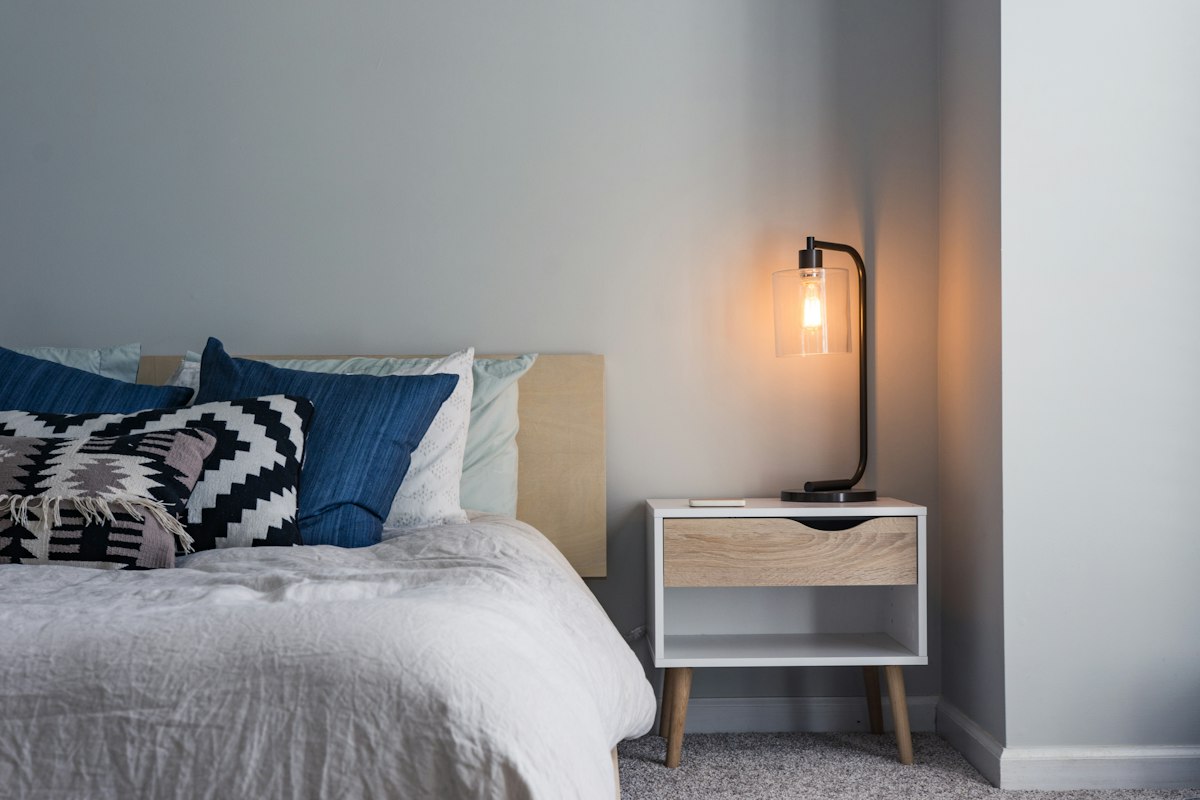
Nothing undermines a beautifully designed bedroom faster than harsh overhead lighting. A single ceiling-mounted light fixture, particularly a downlight or fluorescent, floods the room with flat, unflattering light that eliminates shadow, depth, and atmosphere. Luxury hotel rooms never use a single overhead source. They use layers.
The layered lighting formula for a luxury bedroom: one ambient source (ceiling fixture on a dimmer, set low), two bedside table lamps or wall sconces (warm white bulbs, 2700K, not daylight), and one accent source (a floor lamp in a reading corner, or concealed LED strip behind a bedhead). This creates pools of warm light that make the room feel intimate, three-dimensional, and intentionally considered.
The bulb temperature matters enormously. Daylight bulbs (5000–6500K) are energising and appropriate for work environments, they are entirely wrong for bedrooms. Warm white (2700K) or extra-warm white (2200K) bulbs create the amber glow associated with candlelight and five-star hotel rooms. This is a free change that transforms the experience of any room.
Cohesive Colour, The Neutral Foundation
Luxury bedrooms are almost always neutral. This is not a creative limitation, it is a deliberate choice rooted in the psychology of rest. Warm neutrals (creams, linens, taupes, warm whites, aged ivories) create a visually quiet environment that signals to the brain that the space is for rest, not stimulation.
The critical distinction is warm versus cool. Warm neutrals, those with yellow, orange, or brown undertones, feel enveloping and cosy. Cool neutrals, those with blue or green undertones, can feel clinical or cold. In Australian bedrooms, where natural light tends to be bright and warm, a warm neutral palette almost always outperforms a cool grey scheme.
Choose one wall colour and apply it consistently. Then select textiles within a two-stop range, slightly lighter and slightly darker than the wall. Add warmth through timber, brass hardware, and natural materials. The result is a room that reads as intentional and expensive without a single bold choice.
Storage That Disappears
Visual clutter is the enemy of perceived luxury. In a hotel room, you notice there is nothing on the floor, no visible cables, no overflowing surfaces. The luxury is partly in what you do not see. In a home bedroom, achieving this requires storage that does the work invisibly.
Built-in robes with floor-to-ceiling doors read as architectural elements rather than furniture pieces, they disappear into the room rather than imposing upon it. If built-ins are beyond budget, freestanding wardrobes in the same colour as the wall produce a similar effect. Bedside tables with drawers keep surfaces clear. An ottoman at the foot of the bed provides seating and concealed storage simultaneously. The aim is a room where your eye has nowhere to snag, no visual interruptions, no objects without purpose.
Where to Invest vs Where to Save
| Category | Invest Here | Save Here | Rationale |
|---|---|---|---|
| Mattress | Yes, prioritise above all else | Never compromise | Used 8+ hours daily for 8–10 years; directly impacts health and sleep quality |
| Bed Frame | Yes, solid timber or quality upholstery | Avoid particleboard or flat-pack | Visual anchor; structural integrity matters; cheap frames creak and wobble |
| Bed Linen | Yes, 100% linen or 500TC+ cotton | Mid-range sets adequate for throw pillows | Daily skin contact; quality improves with washing; directly affects sleep comfort |
| Pillows | Sleeping pillows, yes | Decorative Euro pillows, save | Sleeping pillow quality affects neck alignment and sleep quality significantly |
| Bedside Lamps | Quality shade and bulb, yes | Base design, save | The light quality matters more than the lamp aesthetics |
| Artwork | No, save here | Yes, prints, op shop finds | Artwork is decorative; one or two large prints framed simply outperform many small pieces |
| Rugs | No, mid-range adequate | Yes, natural fibre flatweave | Rugs are largely hidden under furniture; texture matters more than brand |
| Window Treatments | Yes, blackout lining is non-negotiable | Curtain fabric, mid-range fine | Sleep quality depends on light control; blackout lining is a sleep hygiene essential |
| Decorative Objects | No, restraint is the luxury | Yes, edit ruthlessly | Visual clutter undermines all other investments; less is always more in a luxury bedroom |
Frequently Asked Questions
More from the Sleep Guide


Visit our O'Connor showroom to try our mattresses and furniture in person, or book a free consultation with one of our sleep specialists.
Book a Free Consultation